
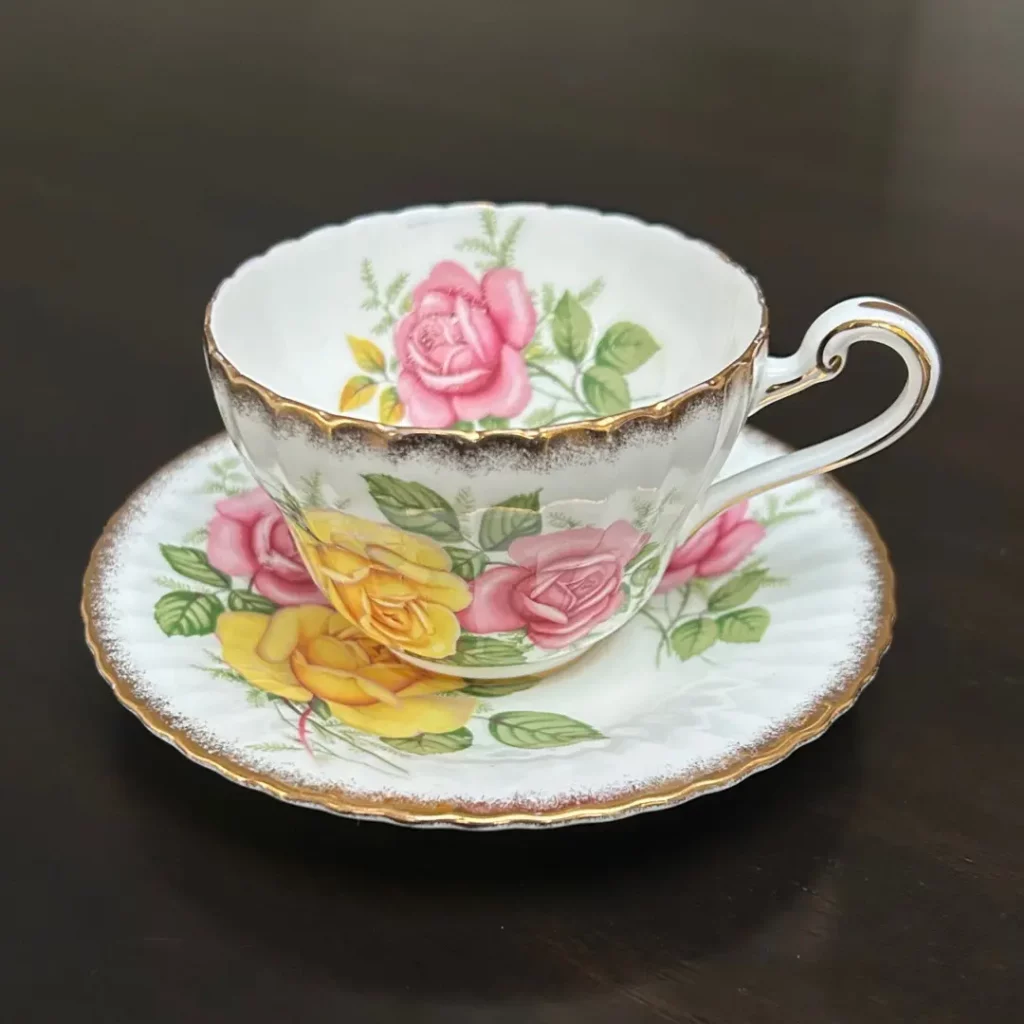
Paragon China: The Story Behind the Double Royal Warrant
If you collect English bone china, you have probably held a Paragon cup and turned it over to read the backstamp. On the best pieces it says something remarkable: “By Appointment to H.M. The Queen & H.M. Queen Mary.” Two queens, one tiny cup. That double warrant is the reason Paragon remains one of the most collected names in vintage teaware — and why it is worth knowing how to read it.
From Star China to Paragon
Paragon began in Longton, Stoke-on-Trent, as the Star China Company, founded in 1897 by Herbert Aynsley — great-grandson of the founder of Aynsley China — and his son-in-law Hugh Irving. The trade name “Paragon” was in use from about 1900, and in 1919 the company formally adopted it, becoming the Paragon China Company. It was incorporated as Paragon China Ltd. in 1930.
From the start, Paragon aimed at the top of the market: fine bone china teaware and tableware, elegant patterns, and a thin, translucent body that collectors still prize today.
Royal patronage
Paragon’s royal connection began in 1926, when the Duchess of York (later Queen Elizabeth, the Queen Mother) commissioned china for the nursery of the infant Princess Elizabeth. The warrants followed:
- 1933 — Queen Mary granted a Royal Warrant of Appointment
- 1937 — King George VI and Queen Elizabeth granted a warrant for their coronation
- 1938 — Queen Elizabeth (the future Queen Mother) granted a warrant
- 1953 — Queen Elizabeth II granted a warrant
A backstamp reading “By Appointment to H.M. The Queen & H.M. Queen Mary” records two of those warrants at once — Queen Mary’s from 1933 and Queen Elizabeth’s from 1938. When you see it, you are holding a piece made after 1938, from a maker the Royal Family bought from for decades.
The wartime Patriotic Series
Paragon’s most storied pieces date from the Second World War. The “Hearts of Oak” cup and saucer belongs to the Patriotic Series, marked “Produced during War of Britain” — made around 1940–41, while Britain was under attack. The navy theme, the oak-leaf border, and the double royal warrant make it a small piece of home-front history as much as a teacup. A Hearts of Oak cup and saucer recently sold through our shop for CA$50.
How to read a Paragon backstamp
The base of the cup tells you most of what you need to know:
- The star mark — the early Paragon mark, a star with the Paragon name, was used from about 1920 to 1932.
- “Paragon Fine Bone China, Made in England” — the standard mark on most pieces.
- “By Appointment” with the royal arms — the warrant mark. Two named monarchs means a double warrant, dating the piece to 1938 or later.
- “Regd” — the design was registered.
- “Royal Paragon” — used only briefly in the early 1930s and then dropped; it was not permitted under the terms of the warrant.
Pattern names and numbers are usually printed or stamped beside the mark. If the cup and saucer carry different backstamps, they may not be an original pair — worth checking before you buy.
What to look for when buying
Paragon made quality china, but ninety years of use leaves traces. Before buying any vintage piece:
- Check the rim, foot, handle, and spout for chips — run a fingertip slowly around the rim.
- Hold it up to the light to spot hairline cracks and crazing (fine lines in the glaze).
- Look at the gilt — wear on the gold rim is normal with age, but heavy loss hurts value.
- Check the saucer matches — same pattern, same backstamp, same period.
- Smell and stain — tea staining inside the cup is common and usually cleans off; a musty smell can mean long damp storage.
A clean, matched, undamaged piece is always worth more than a rare pattern with a chip.
The end of the line
In 1960 the Irving family sold the business to Thomas C. Wild & Sons, makers of Royal Albert. Paragon passed into Allied English Potteries in 1964 and the Royal Doulton group in 1972, and the Paragon name was phased out in the early 1990s. That is good news for collectors in one way: no new Paragon is being made, so every genuine piece is vintage, and the backstamp is your best guide to what you are holding.
Browse our current Paragon pieces in the shop — and if you are unsure about a mark on a piece you already own, send us a photo of the base. We are always happy to help read it.

